To save for a down payment in 2026, most first-time buyers need between $24,000 and $60,000, depending on your target market and loan type. With 30-year fixed rates at 6.45%, the math still works — but it requires a real savings plan with a specific number, a dedicated account, and a timeline measured in years, not months.
How Much Down Payment Do You Actually Need in 2026?
The 20% rule is a myth for most first-time buyers. The average first-time homebuyer in the US puts down around 8–9%. Here is what the numbers look like across loan types for a $400,000 home — roughly the national median:
| Loan Type | Minimum Down | Amount on $400K | Monthly PMI? |
|---|---|---|---|
| Conventional 97 (Fannie/Freddie) | 3% | $12,000 | Yes (~$120–180/mo) |
| FHA | 3.5% | $14,000 | Yes (for loan life) |
| Conventional 80/20 | 20% | $80,000 | No |
| VA / USDA | 0% | $0 | No |
The 20% threshold matters because it eliminates private mortgage insurance (PMI), which adds $100–$200 per month to your payment. At 6.45%, that monthly PMI hits harder than it did at 3%. But waiting years longer to reach 20% while renting may cost more in total than paying PMI for two to three years until you cross the equity threshold.
A practical middle ground: aim for 10–15% down, which cuts your PMI cost roughly in half and keeps your savings timeline under four years in most markets.
How Long Will It Take to Save?
The honest answer depends on your income, current rent, and savings rate. Let’s use realistic numbers.
If the median US household income is roughly $80,000 (about $5,500/month after tax), and rent absorbs $1,800, that leaves about $3,700 for everything else. Saving aggressively means putting 20–30% of take-home pay toward your goal — $1,100 to $1,650 a month.
| Monthly Savings | $20,000 Goal | $40,000 Goal | $80,000 Goal |
|---|---|---|---|
| $500/month | 3.3 years | 6.7 years | 13.3 years |
| $1,000/month | 1.7 years | 3.3 years | 6.7 years |
| $1,500/month | 1.1 years | 2.2 years | 4.4 years |
These do not include interest earned on your savings. A high-yield savings account at 4.5–5% APY (offered by Ally, SoFi, and Marcus by Goldman Sachs) shaves six to twelve months off most timelines.
If you are in a high-cost metro — San Francisco, Seattle, New York — the math is harder. A $700,000 purchase needs $70,000 for a 10% down payment. In that case, explore down payment assistance programs before assuming you need to save the full amount yourself.
The Best Accounts for Your Down Payment Savings
Where you hold the money matters more than most people think. Down payment savings are not emergency funds — they have a target date, which opens up slightly better options.
High-yield savings account (HYSA): Best for timelines under two years. Ally, Capital One 360, and SoFi currently offer 4.5–5% APY. Fully liquid, FDIC-insured. The right default choice for most people.
Treasury I Bonds: Inflation-linked, currently yielding around 3.1%. You can only purchase $10,000 per year through TreasuryDirect, and there is a one-year lock-up period. Better for long-term savers (3+ years out) who want inflation protection.
No-penalty CDs: Fidelity and Discover offer no-penalty CDs with rates slightly above HYSAs. Slightly less flexible but marginally higher yield. Good if you are sure you will not need the money for 6–12 months.
Avoid: the stock market for a purchase within three years. Market timing is not a savings strategy — a 20% correction the year you plan to buy would wipe out years of progress.
How to Find More Money to Save Each Month
Most people cannot simply decide to save $1,500 a month without changing something. Tracking your expenses for 30 days before you set a savings number is almost always revealing.
Common categories that free up meaningful money:
- Food delivery (DoorDash, Uber Eats, Instacart): The average American spends $165/month on delivery apps. Cutting by half saves $80–$100/month.
- Subscriptions: Netflix, Hulu, Disney+, Spotify, gym membership, Amazon Prime. Most households are paying $180–$250/month in subscriptions, half of which they rarely use.
- Dining out: A $15 weekday lunch five days a week is $300/month. Bringing lunch three days a week saves $180.
- Grocery optimization: Shifting from Whole Foods to Trader Joe’s or Costco for staples saves $150–$250/month for a household without significant sacrifice in quality.
Realistically, a focused audit using a tool like Tefteri to categorize spending by domain often reveals $300–$500/month that can move directly to a down payment account. That alone is the difference between a four-year and a two-year savings timeline.

Down Payment Assistance Programs — Check Before You Assume
There are currently over 2,600 down payment assistance (DPA) programs in the US, according to the National Association of Realtors. The average benefit is around $18,000. Many are state or county-specific, income-limited, and underutilized because buyers do not know they exist.
Start at your state’s housing finance agency website. Common structures:
- Forgivable loans: You receive assistance that is forgiven after 5–10 years of residency — effectively a grant.
- Deferred payment loans: You repay when you sell or refinance, not monthly.
- Matched savings programs: For every $1 you save, the program adds $1–$4, up to a cap.
These do not replace your savings plan — most require you to contribute something — but they can meaningfully shorten the timeline.
Common Down Payment Mistakes
Saving in checking. If your down payment savings sit in the same account as your daily spending, they will disappear gradually. A separate, named account creates a psychological barrier.
Not accounting for closing costs. Closing costs typically run 2–5% of the loan amount. On a $350,000 loan, that is $7,000–$17,500 — money you need in cash at closing, in addition to the down payment.
Pausing retirement contributions entirely. If your employer offers a 401(k) match, stopping contributions costs you free money. A better approach: contribute enough to get the full match, then redirect everything above that to your down payment savings.
Chasing a perfect market. Buyers waiting for rates to drop from 6.45% to 5% have been waiting for two years and may wait two more. The inflation environment and Fed rate cycle do not move on a predictable schedule. Buy when the math works for your household, not when pundits predict.
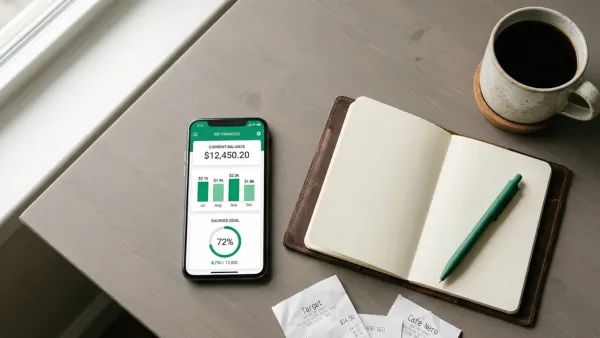
Use Tefteri to set a named savings goal with a target date, then watch your Housing domain balance grow alongside your current rent costs — seeing both numbers together is a powerful reminder of what you are working toward.
Tefteri is a personal finance app for iPhone that helps you track expenses, income, and savings goals — organized by category, stored locally on your device, and built to make financial clarity effortless.
Frequently Asked Questions
How much should I save for a down payment in 2026?
For most first-time buyers, a realistic target is 10–15% of the purchase price, plus 3–5% for closing costs. On a $350,000 home, that means saving $35,000–$52,500 before you close. You can buy with less (3–3.5% via FHA or Conventional 97), but PMI at current rates adds meaningful monthly cost.
How long does it take to save for a down payment?
At $1,000/month in savings, you will reach a $40,000 goal in about 3.3 years. At $1,500/month, you reach it in just over 2 years. The single fastest lever is finding and eliminating spending categories you rarely value — most households have $300–$500/month available without major lifestyle changes.
Should I wait for mortgage rates to drop before buying?
Waiting is only a good strategy if you would use that time to save more and rates do drop. If you are ready financially, buying now and refinancing when rates fall is a realistic option. Historically, every 1% rate drop triggers a refinancing wave. The risk is waiting years for a rate drop that does not materialize while rent keeps climbing.
Is it better to put 20% down or invest the difference?
At 6.45% mortgage rates, eliminating a 6.45% guaranteed debt (plus PMI) is a better guaranteed return than most low-risk investments can reliably beat. The calculus shifts when rates are at 3% — not at 6.45%. For most buyers in today’s environment, 20% down makes mathematical sense if the timeline is under three years.
What is a down payment assistance program and how do I find one?
Down payment assistance programs are government and nonprofit grants or low-interest loans that supplement your own savings. Most are run at the state or county level. Start at your state’s housing finance agency (HFA) website, or search the Consumer Financial Protection Bureau’s homebuying resources. A HUD-approved housing counselor can also identify programs you qualify for at no cost.