Most financial experts agree on the target: 3 to 6 months of essential living expenses, held in a liquid, FDIC-insured account. For a single person with $2,870 in monthly essentials, that means $8,600 to $17,200. For a family of four with $5,500 in baseline costs, the target is $16,500 to $33,000. The hard part is not knowing the number — it is building it when 47% of Americans cannot cover a single $1,000 emergency from savings today.
The 2026 Emergency Savings Reality Check
NerdWallet’s Consumer Financial Resilience Index debuted in May 2026 with a score of 60.4 out of 100 — described as “moderate resilience, but plenty of room for growth.” The underlying data is sobering: 37% of Americans say they will rely on credit to cover at least some expenses this month. Bankrate’s 2026 Emergency Savings Report found that only 47% could handle a $1,000 emergency without borrowing, and 24% have no emergency savings at all.
Consumer pessimism is at its highest since Bankrate started tracking in 2018, with 32% of Americans expecting their finances to worsen in 2026. Inflation is the most-cited culprit — 54% say rising prices are making it harder to set anything aside.
The 3-to-6-month rule gets repeated everywhere, but most articles stop there. Here is the math that actually tells you your number.
How to Calculate Your Emergency Fund Target
The mistake most people make is calculating off total monthly spending. The emergency fund is not meant to replace your lifestyle — it is meant to keep you housed, fed, and insured while you fix the problem. That means building your baseline from essential expenses only.
What to include:
- Rent or mortgage payment (including renter’s/homeowner’s insurance)
- Groceries — bare-bones home cooking only, no restaurants
- Utilities: electricity, gas, water, internet (you need internet to job hunt)
- Health insurance premiums — and account for COBRA if you lose employer coverage, which averages $600–$700/month for an individual
- Minimum debt payments: credit card minimums, student loans, car loan
- Transportation: gas and car insurance, or a transit pass
- Basic phone plan
What to exclude:
- Dining out, coffee shops, takeout
- Streaming subscriptions (Netflix, Hulu, Disney+)
- Gym memberships
- Shopping and clothing beyond urgent needs
- Entertainment and vacations
Example — single person in Austin, TX:
| Category | Monthly Cost |
|---|---|
| Rent (1BR) | $1,400 |
| Groceries | $300 |
| Utilities (electricity, gas, water, internet) | $250 |
| Phone | $70 |
| Car insurance + gas | $250 |
| Health insurance premium | $350 |
| Minimum debt payments | $250 |
| Essential monthly total | ~$2,870 |
- 3-month target: $8,600
- 6-month target: $17,200
The national average household spends $6,545/month across all categories, but the essential baseline for most single Americans lands between $2,500 and $3,500 — much less than total spending.
3, 6, or 9 Months — Which Is Right for You?
The classic 3-to-6 range is a starting framework. The right number depends on your income stability:
3 months works if both partners are employed, you have stable W-2 income, and you work in a sector with strong demand (healthcare, tech, government).
6 months is appropriate for single-income households, anyone with dependents, people in cyclical industries (real estate, construction, media), and anyone whose job would take more than three months to replace.
9 to 12 months is the right target for 1099 workers, freelancers, commission-based salespeople, and gig economy workers. You have no employer-sponsored unemployment insurance, income is irregular, and a slow quarter hits you immediately. About 16% of the US workforce falls into this category.
For context: the BLS reports a median unemployment duration of roughly 11.5 weeks (about 2.8 months) as of early 2026. A 3-month fund covers the median job loss scenario. But 25% of unemployed workers stay jobless for 27+ weeks — meaning 1 in 4 people need a 6-month fund to avoid going into debt before finding work.
Where to Keep Your Emergency Fund in 2026
Your emergency fund has one job: be there when you need it. That means three requirements — liquid (accessible within 1–2 business days), safe (FDIC insured up to $250,000), and not invested (no stock market risk).
The best vehicle in 2026 is a high-yield savings account (HYSA). Top rates as of May 2026:
| Account | APY | Minimum | FDIC |
|---|---|---|---|
| SoFi Savings (with direct deposit) | 4.50% | $0 | ✓ |
| Marcus by Goldman Sachs | 4.25% | $0 | ✓ |
| Ally Bank Online Savings | 4.20% | $0 | ✓ |
| Discover Online Savings | 4.25% | $0 | ✓ |
| Average traditional bank savings | 0.38–0.46% | varies | ✓ |
On a $9,000 emergency fund, the difference between Ally at 4.20% and your local bank at 0.40% is $342/year in interest — free money for doing nothing extra.
What to avoid: Time deposits and CDs lock up your money and charge early withdrawal penalties. The stock market is not an emergency fund — if the S&P 500 drops 30% the same month you lose your job, you would be forced to sell at a loss exactly when you need the cash most.

A practical structure for larger funds: keep one to two months of expenses in a HYSA for immediate access, and put the rest in I Bonds (currently 3.68% APY, inflation-indexed, state-tax-exempt) or a CD ladder. I Bonds have a 12-month lock-up period and a 3-month interest penalty if redeemed in the first five years — so they only work for the portion you genuinely would not need for at least a year.
Building the Fund While Paying Off Debt
This is the most common conflict: should you pay down high-interest debt or build emergency savings first?
The short answer: do both, but in the right order. Here is the framework most CFPs now recommend:
-
Start with a $1,000–$2,000 starter emergency fund. Dave Ramsey’s Baby Step 1 famously pegs this at $1,000, but in 2026 that barely covers one ER copay or one transmission repair. A better starter is one month of essential expenses, or $2,000 minimum.
-
Attack high-interest debt aggressively. If you carry credit card debt at 24% APR, paying it down is mathematically equivalent to earning a 24% guaranteed return. No HYSA matches that.
-
Once high-interest debt is cleared, build to 3–6 months. Redirect the monthly payment you were making toward your debt into the HYSA instead.
The exception: if you have no buffer at all, every unexpected expense goes back onto the credit card, creating a treadmill you can never escape. The $1,000–$2,000 starter fund breaks that cycle before you begin the debt paydown.
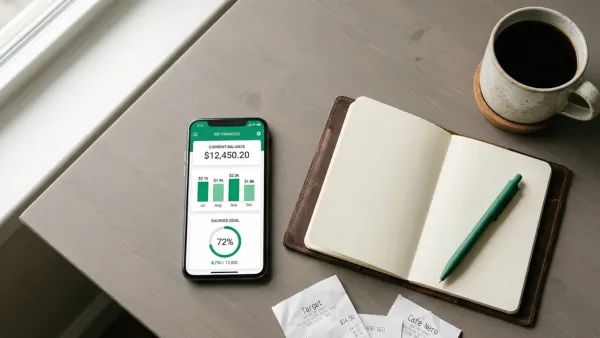
Once you know your spending, use Tefteri to track your actual essential expenses each month — manually logging rent, groceries, and utilities across categories gives you a real baseline number instead of a guess. You can also set a Savings Goal directly in the app to track your progress toward your 3- or 6-month target.
Read more: How to Track Your Expenses in 2026 and 5 Budgeting Methods Compared to find a system that fits how you manage money day to day.
Tefteri is a personal finance app for iPhone that helps you track expenses, income, and savings goals — stored privately on your device, no bank linking required. Set your emergency fund target and watch it grow one month at a time.
Frequently Asked Questions
How much should I have in an emergency fund in 2026?
The standard target is 3 to 6 months of essential living expenses — not total spending. For most single Americans, that means $8,000 to $18,000 depending on your city and cost of living. If you are self-employed, a 1099 contractor, or work in a volatile industry, aim for 9 to 12 months. Start with a $1,000 to $2,000 starter fund if you have nothing saved, and build from there.
What is the best account for an emergency fund right now?
A high-yield savings account (HYSA) at an online bank is the best combination of safety, liquidity, and return. In May 2026, Ally (4.20% APY), Marcus by Goldman Sachs (4.25%), and SoFi (4.50% with direct deposit) are among the top options — all FDIC insured, no minimum balance, no monthly fees. Traditional big-bank savings accounts pay 0.38–0.46% on average, which is significantly lower.
Should I build an emergency fund or pay off debt first?
Build a small starter buffer ($1,000–$2,000) before aggressively paying down debt. Without any emergency savings, every unexpected expense forces you to borrow again and undo your debt payoff progress. Once you have that starter cushion, direct extra cash toward high-interest debt (20%+ APR cards) first — that is the best guaranteed return available. Then rebuild to a full 3- to 6-month fund after the high-interest debt is gone.
Does an emergency fund need to earn interest?
It should, but yield is secondary to accessibility. Your emergency fund needs to be available within 1–2 business days, with no withdrawal penalties. High-yield savings accounts currently offer 4–4.50% APY while maintaining full liquidity — that is the best of both. Avoid CDs (early withdrawal penalties), I Bonds (12-month lock-up), or stock market investments (price volatility) for money you might need on short notice.
How long does it take to build a 3-month emergency fund?
At $200/month saved, building a $9,000 fund (3 months for a typical single person) takes 45 months — just under 4 years. At $400/month, it takes about 22 months. The fastest path is to automate a fixed transfer to your HYSA on payday, before the money can be spent on other things. Even $100/month gets you to a $1,200 starter fund in a year — enough to cover most car repairs or medical copays without reaching for a credit card.